 libreAdamlibreAdam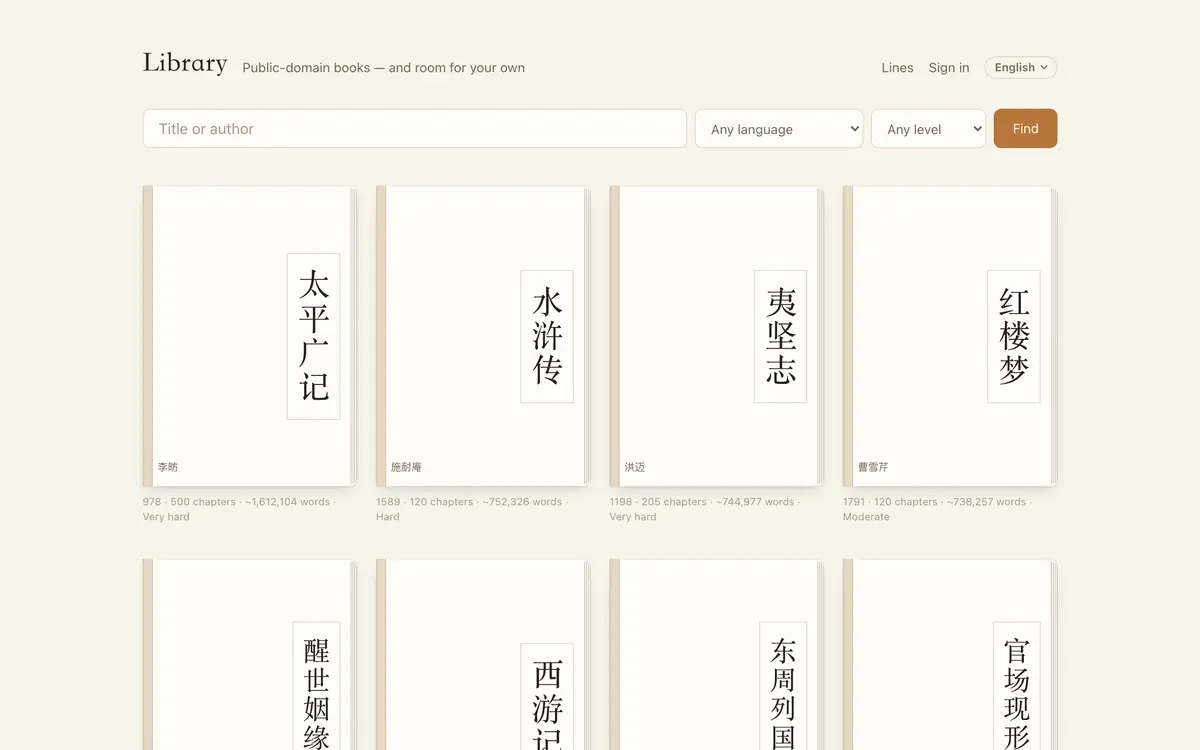
Reader
阅读器
Public-domain books shelved by where you are — and your own books fit too.
Visit the site →What is it
Public-domain books are shelved according to where the reader is. Copyright is territorial — the same book can be free to read in Canada and still locked in the EU — so the library never stores the conclusion “is this public domain.” It stores the facts: the year the author died and the year the work was published, and works out the answer for your jurisdiction on the spot, with a separate rule set for Canada, the US, the EU, mainland China, Hong Kong and Taiwan, Japan and New Zealand. Which means every January 1st the shelf grows a fresh batch of books on its own, with no script to run. Your own books fit too: upload an epub or a txt and it belongs to your account alone — it never enters a public query, and it can’t be given away. Page turns are a real sheet curling around a cylinder, cut into 20 slices that each hold real text, so the words stay sharp while the page is moving. Chinese can be shown with ruby pronunciation, and a character it isn’t sure about is left blank rather than guessed. Drag across a word to look it up, keep it in your word list, and it comes back to ask you a few days later — with the sentence you were actually reading as the example, not one from the dictionary. The AI companion answers one kind of question — what does this line, this person, this word mean, at the point I’ve read to — and only retrieves chapters you’ve reached; it has also read the book itself, which is why the panel says outright that it will try not to spoil anything but can’t promise. Poetry is indexed by line, because the question worth answering is “I ran into half a good line once — where is it from?”: a wall of famous lines, a line a day, and a half-remembered fragment that finds the whole poem. The shelf sorts into six difficulty bands, and a book that hasn’t been graded is counted in none of them.
Highlights
- Public-domain status is computed for your jurisdiction on the spot, six rule sets — and every January 1st the shelf grows a new batch by itself
- Upload your own books (epub / txt); a private book never enters a public query, and can’t be given away
- The page turn is a real sheet curling over — 20 slices, each holding real text, so the words never blur mid-turn
- Look up → word list → review when due, with the sentence you were reading as the example, not a dictionary one
- The AI companion only retrieves chapters you’ve reached — and says on screen that it can’t promise no spoilers
- Poetry indexed by line: a wall of famous lines, a line a day, and a half-remembered fragment that finds the whole poem
- Ruby pronunciation is left blank rather than guessed; the shelf filters by six difficulty bands, and un-graded books fall into none
Related
 GoldNest GoldNestLog a spend in one sentence — and dig out the subscriptions you forgot to cancel.
 ClipArc ClipArcNever lose what you copied — hit Cmd+Shift+V and it’s all still there.
 BigBro BigBroLocks distracting apps and websites while you focus, with supervisors and study rooms.
 Cloudtown CloudtownAn AI character who lives in a pixel cottage. Chat with it, and it keeps notes for you.